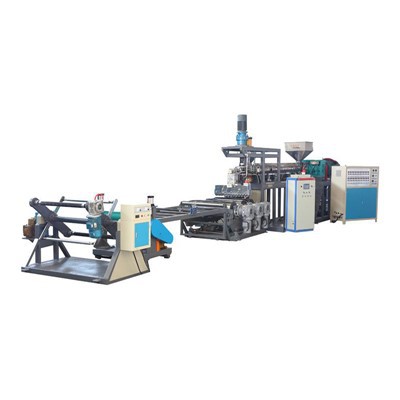
Hey there! As a supplier of Mat Extruders, I'm super stoked to dive into the nitty - gritty of the cooling methods used in these machines. It's a topic that doesn't get enough love, but it's crucial for the performance and quality of the final product.
Let's start with why cooling is so important in a Mat Extruder. When the material is being extruded, it goes through a high - temperature process. If the heat isn't managed properly, it can lead to all sorts of issues. The material might degrade, lose its properties, or the extruded mat might have an uneven texture. So, a good cooling method is like the secret sauce that keeps everything in check.
One of the most common cooling methods is air cooling. This is a pretty straightforward approach. Air is blown over the extruded mat to carry away the heat. It's simple, cost - effective, and doesn't require a lot of complex equipment. You can use fans to direct the air flow. The speed of the air and the temperature of the incoming air can be adjusted to control the cooling rate. For example, if you're working with a material that cools quickly, you might not need a high - speed air flow. On the other hand, for materials that hold heat longer, a faster air flow can help speed up the cooling process.
Another popular method is water cooling. Water is a great heat conductor, and it can absorb a large amount of heat quickly. In a water - cooling system for a Mat Extruder, the extruded mat passes through a water bath or is sprayed with water. The water takes the heat from the mat and carries it away. There are different setups for water cooling. Some systems use a continuous water bath where the mat moves through it, while others use spray nozzles to mist the mat. The advantage of water cooling is that it can cool the mat much faster than air cooling. However, it also has some drawbacks. You need to have a proper water treatment system to prevent corrosion and scale build - up in the equipment. And, of course, you have to deal with the water disposal or recycling.
Now, let's talk about some advanced cooling methods. One of these is liquid nitrogen cooling. Liquid nitrogen is extremely cold, with a temperature of around - 196°C. When it's used for cooling in a Mat Extruder, it can rapidly cool the extruded mat. This is especially useful for materials that need to be cooled very quickly to maintain their properties. For example, in TPU Extrusion, liquid nitrogen cooling can help in achieving the right molecular structure of the TPU material. But using liquid nitrogen has its challenges. It's expensive, and you need special equipment to handle it safely.
There's also glycol cooling. Glycol is a type of antifreeze that can be used in a cooling system. It has a lower freezing point than water, which makes it suitable for applications where the cooling needs to be done at lower temperatures. In a glycol - cooling system, the glycol is circulated through a heat exchanger that is in contact with the extruded mat. The glycol absorbs the heat and then transfers it to a cooling tower or another heat - dissipation device. This method is often used in industrial settings where precise temperature control is required.
When it comes to choosing the right cooling method for your Mat Extruder, there are a few factors to consider. First, the type of material you're extruding plays a big role. Different materials have different heat - transfer properties and cooling requirements. For instance, materials like TPE and TPU have different melting points and cooling rates. In TPE Extrusion, you might need a different cooling approach compared to other materials.
The production speed is another important factor. If you're running a high - speed production line, you'll need a cooling method that can keep up. For example, if you're using a Double Screw Extruder Machine that can extrude at a fast pace, air cooling might not be sufficient, and you might need to opt for water or liquid nitrogen cooling.
The cost is also a major consideration. Air cooling is the cheapest option, but it might not be the most efficient for all applications. Water cooling is more expensive due to the need for water treatment and disposal, and liquid nitrogen cooling is the most costly. You need to balance the cost with the performance requirements of your production.
As a Mat Extruder supplier, I've seen firsthand how the right cooling method can make a huge difference in the quality of the final product. Whether you're a small - scale manufacturer or a large industrial operation, choosing the appropriate cooling system is essential.
If you're in the market for a Mat Extruder or need advice on the best cooling method for your specific application, don't hesitate to reach out. We're here to help you make the right decision and ensure that your production runs smoothly.
References:


- Industry reports on extrusion technology
- Technical manuals of Mat Extruders
- Research papers on polymer cooling processes